Some questions linger.
Like the taste of regret, or grief, or rage—or all three stirred into a casserole you didn’t ask for but now find yourself chewing slowly. Questions that hang out in your gut, refuse to be digested, and sneak back up when you’re just trying to fall asleep.
Here’s mine lately:
How do we ever come out of this?
I don’t just mean Trump. He’s more symptom than cause, more cartoon villain than criminal mastermind. He didn’t build the machine—but he sure figured out how to ride it.
No, I’m talking about the era.
The unmaking of truth.
The sanctification of cruelty.
The rise of white Christian nationalism dressed up in Jesus drag.
The celebration of power for power’s sake.
The children in cages.
The book bans.
The rolling back of rights.
The quiet normalization of authoritarian dreams.
I’m talking about the way you feel after scrolling headlines: hollowed out and reeling.
I’m talking about the gnawing fear that this country has been unraveling for a long time—and maybe we were never who we said we were to begin with.
So how do we come out of this? How do we survive the era of Epstein and Project 2025 and everyone pretending it’s just politics-as-usual?
How do we not go numb?
I remember the day after the 2016 election. I didn’t speak. Not one word. I walked around the house like a ghost—mute, stunned, gut-punched. Not because I hadn’t seen the possibility. But because the country had picked him. On purpose. It was like watching a car crash you can’t stop, only to realize it’s your house they’re crashing into.
Eventually, I numbed. I unplugged from the news, unfollowed the political accounts, stopped watching the commentators. Life went “back to normal”—or maybe we just normalized it. That’s what empire does. It makes the unbearable seem routine.
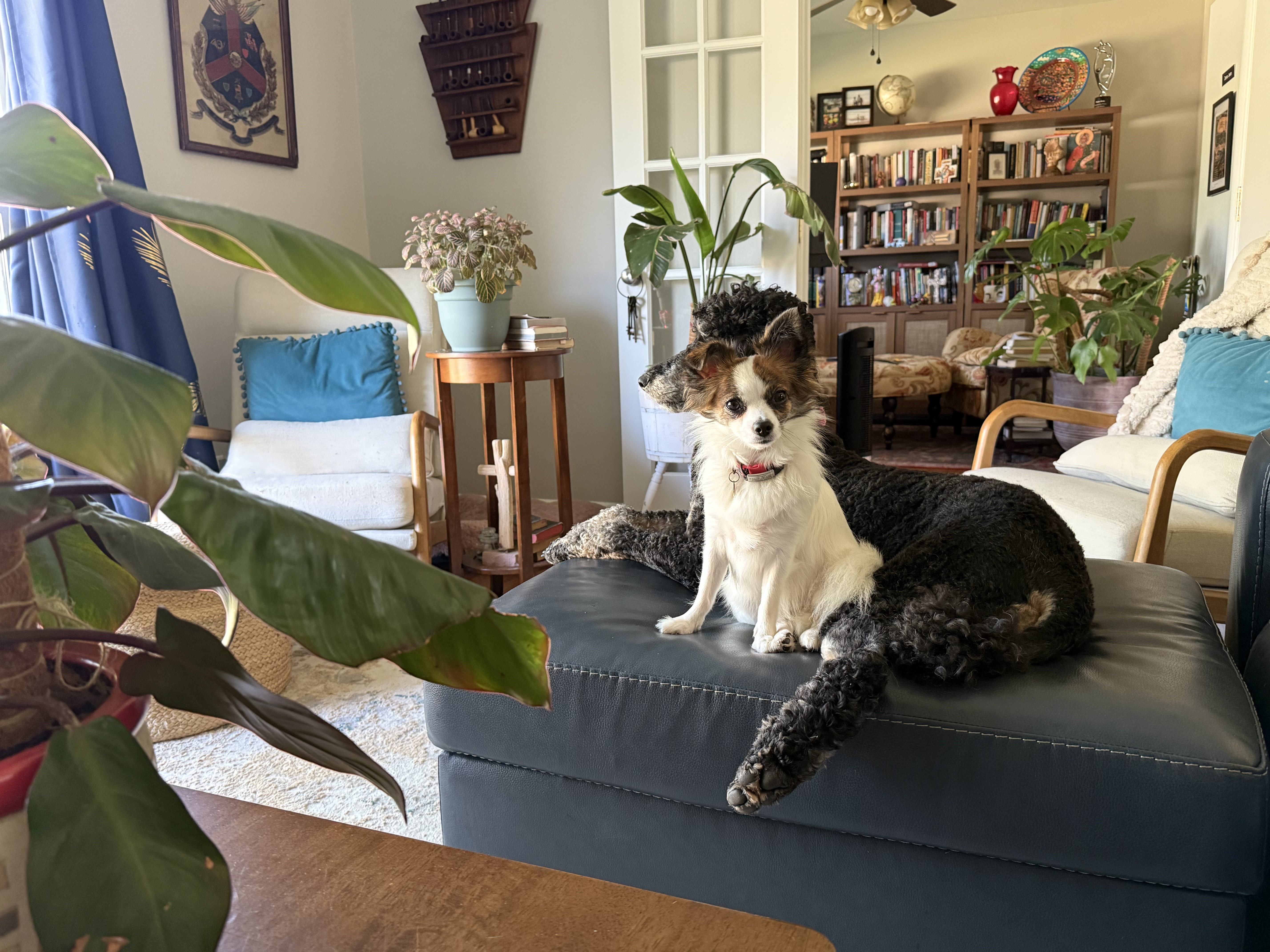
Then came 2024. And the morning after that election, Joan of Bark and I walked into the Pet Place.
We weren’t supposed to come home with anyone. I had rules. Requirements. No shedding. Medium-sized. Three years old, at least. And Joanie had opinions too. She turned her nose up at every dog they brought out—walking away, sitting with her back turned, clearly unimpressed.
Until they brought out Gidget.
A chihuahua.
Not just not on the list—the opposite of the list.
Tiny, shedding, high-energy chaos in a fur coat.
But Joanie’s whole demeanor changed. She ran to me wiggling and wagging like she’d found her long-lost sister. She sniffed Gidget all over, nuzzled her, looked up at me like: this one. we need her.
And she was right.
There was something about Gidget—her ridiculous sass, her puppy energy, her comic mischief—that broke through the numbness. We didn’t plan for her. But she was the unexpected joy we didn’t know we needed.
And sometimes, when the world breaks open and everything feels like rubble, the best you can do is choose love in an unexpected form.
Sometimes the revolution starts with a chihuahua.

She didn’t fix anything, of course. But she reminded me what still matters. That joy is resistance. That companionship is sacred. That the work of healing doesn’t always come in the package we expect.
And that’s where I begin again:
- I tell the truth—in my preaching, in my teaching, in the stories I tell and the silence I refuse to keep.
- I build community—in shared meals and messy meetings, in the check out line at the grocery store, and in parking lot prayers.
- I refuse to rush hope—but I don’t let despair set up camp either.
- I get strategic—I pay attention, I protest where I can, I rest when I need to, and I stay in the fight.
- I hold close the people who remind me who I am.
It doesn’t fix everything. But it keeps me from shutting down. It keeps me human.
That’s what this series is about. Not answers, exactly. But breadcrumbs on the long road out. Not reheated platitudes, but leftover truth: sometimes bruised, often uncomfortable, always offered in love.
If you’re reading this and you’re tired, me too.
If you’re angry, good.
If you’re grieving, stay tender.
If you’re still showing up—at school board meetings or church basements or neighborhood food pantries—you’re part of the way forward.
I’m going to write my way through. If you need company, you’re welcome to follow along. I won’t promise answers. But I’ll tell the truth, as best I can. And maybe, together, we’ll start to remember who we are.
Let’s not pretend it’s fine. Let’s say what’s real. And then let’s figure out how to live like we mean it.
Dana+
 Invisible Leftovers